The Return of the Hand-Off: Why Brands Are Rediscovering In-Person Brochure Distribution — and Why Gen Z Is Responding
An opinion piece from the InterBrochure editorial team.
Let me offer a claim that will strike some readers as counterintuitive, possibly even contrarian: handing a brochure directly to another human being may be one of the most sophisticated marketing moves available to a brand operating in 2024.
Not because print is nostalgic. Not because digital has failed. But because the cultural conditions that made direct, in-person distribution feel outdated have quietly reversed themselves — and the brands paying attention are gaining ground.
The Saturation Problem That Nobody Wants to Admit
The average American adult now encounters somewhere between 4,000 and 10,000 brand messages per day, depending on whose estimate you trust. The precise figure matters less than the underlying reality: digital advertising has industrialized attention capture to a degree that has fundamentally altered how audiences process promotional content.
The result is not simply banner blindness. It is a generalized posture of defensive skepticism toward anything that arrives through a screen. Targeted social ads, email sequences, retargeting campaigns — audiences have developed sophisticated internal filters for all of it. Engagement rates across most digital channels have trended downward for years, even as targeting capabilities have grown more precise.
Against this backdrop, something interesting is happening in the physical world.
Why Gen Z Is the Unexpected Protagonist Here
The conventional narrative about Generation Z — born between the late 1990s and early 2010s — positions them as the native digital audience for whom physical marketing is irrelevant. That narrative is increasingly difficult to defend with evidence.
Several dynamics complicate the simple story. First, Gen Z has grown up entirely inside a digital advertising ecosystem. They have never known a version of the internet without targeted ads, sponsored content, and algorithmic curation. The result is not digital enthusiasm but digital fatigue — a cohort that is, by many measures, more skeptical of online advertising than any generation before them.
Second, and perhaps more importantly, Gen Z has demonstrated a pronounced and well-documented interest in physical, tangible experiences. The vinyl record resurgence. The return of film photography. The persistence of independent bookstores in markets where they were supposed to have disappeared. These are not isolated quirks. They reflect a coherent cultural preference for objects and experiences that exist outside the screen.
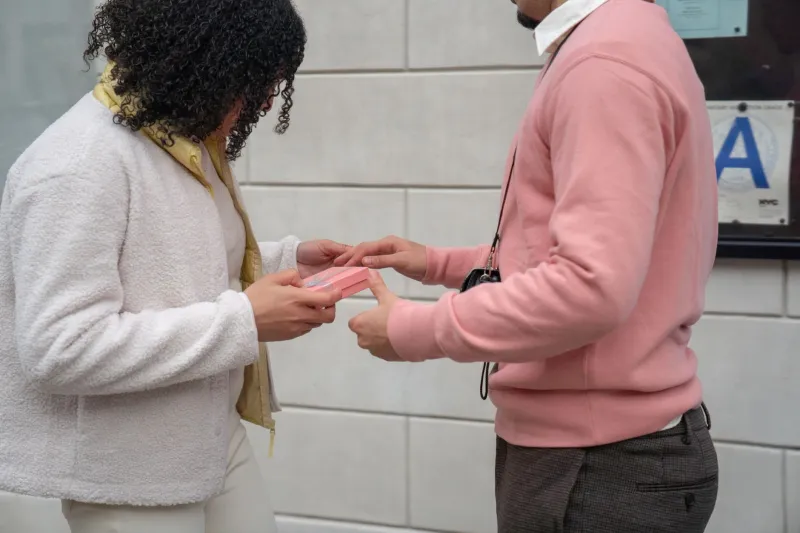
A well-designed brochure, handed directly from one person to another, fits precisely into that preference structure. It is physical. It is personal. It is, in a media environment defined by algorithmic intermediation, genuinely rare.
What "Actually Working" Looks Like Right Now
I want to be specific here, because vague enthusiasm for print is not useful. The in-person distribution strategies that are generating real engagement share several identifiable characteristics.
Context-native placement. The most effective hand-to-hand distribution is happening in environments where the physical exchange feels natural rather than intrusive. Independent coffee shops, farmers markets, local music venues, fitness studios, and community events are all spaces where a thoughtfully designed brochure offered by a knowledgeable brand representative is received as a resource rather than an interruption. The key word is offered — not thrust, not left in a pile, but personally extended.
A regional financial planning firm in the Pacific Northwest piloted a strategy of placing brand representatives at weekend farmers markets in Portland and Eugene, distributing a well-produced, locally relevant brochure series on financial wellness topics. The materials were designed to be genuinely useful independent of any sales intent. Conversion tracking through unique QR codes and dedicated landing pages showed engagement rates that outperformed the firm's email campaign benchmarks by a substantial margin — and the leads generated reported higher average asset values at onboarding.
Design that earns the second look. Brochures distributed in person face an immediate test: will the recipient hold onto it, or discard it at the nearest trash can? The answer depends almost entirely on whether the piece offers immediate, tangible value — information, a compelling visual, a useful reference — rather than purely promotional content. The brands succeeding with hand-to-hand distribution have largely abandoned the traditional sales brochure format in favor of what might be called the "useful object": a piece that functions as a guide, a reference card, a curated recommendation, or a piece of genuinely interesting content that happens to carry brand attribution.
The role of the distributor. This is where many organizations underestimate the investment required. In-person distribution is not a logistics exercise. The person handing the brochure is, in that moment, the most important brand touchpoint in the entire customer journey. They need to be knowledgeable, genuinely enthusiastic, and capable of having a real conversation. The hand-off is not a delivery mechanism — it is the beginning of a relationship.
Challenging the Trade Show Default
For many B2B marketers, "in-person distribution" is synonymous with trade show booth. That association deserves scrutiny. Trade show environments, while valuable for certain objectives, are among the least favorable contexts for meaningful brochure engagement. Attendees are cognitively overloaded, physically fatigued, and accumulating materials from dozens of competing exhibitors simultaneously. The brochure that felt important in the booth frequently ends up in the hotel room trash.
The more productive question is: where does our target audience exist in an unhurried, receptive state? The answer is almost never a convention center floor.
For a B2B software company targeting independent restaurant operators, that receptive state might be a regional restaurant industry association meeting, a culinary festival, or a local food and beverage trade gathering. For a commercial real estate firm, it might be a chamber of commerce breakfast or a neighborhood business improvement district event. These contexts are smaller, less competitive, and more conducive to the kind of genuine exchange that makes in-person distribution valuable.
The Measurement Question
No opinion on distribution strategy is complete without confronting the measurement challenge. In-person distribution is harder to track than digital. That is true. It is not, however, unmeasurable.
QR codes with distribution-specific UTM parameters, unique phone numbers, dedicated landing page URLs, and simple follow-up survey questions at point of conversion can all be deployed to build a reasonable attribution picture. The data will not be as granular as a digital campaign dashboard. But the engagement quality — when measured through lead quality, conversion rate to qualified opportunity, and customer lifetime value — frequently justifies the investment in ways that raw click-through rates do not capture.
A Final Provocation
The brands that will look back on 2024 as a turning point are not those that allocated more budget to programmatic advertising. They are the ones that recognized a genuine gap in the market: the space left by every competitor who abandoned the physical, the personal, and the human in pursuit of digital scale.
Handing someone a beautifully produced brochure and having a real conversation about it is not a step backward. In the current environment, it may be the most forward-thinking distribution strategy available.